 Skip to main content
Atik Cameras & Berkeley University – The APX60 into space

Atik Cameras successfully collaborated with the UC Berkeley to adapt the Apx60 for orbital deployment. The mission was to provide the core imaging technology for the CuRIOS-ED mission, aiming to qualify high-performance commercial electronics for space-based surveys.
The partnership was built on the established reliability of the Apx60, a market-validated platform recognized as a premier solution for its exceptional noise profile and scientific-grade performance. A defining factor in the mission’s success was the flexibility and agility of Atik’s engineering team, which provided deep technical support throughout the implementation. By delivering a customized, board-level electronics stack optimized with automotive-grade components and real-time FPGA telemetry, Atik proved its ability to adapt high-performance commercial technology for the uncompromising demands of extreme space environments.
About the CuRIOS-ED Project
The CuRIOS-ED (CubeSats for Rapid Infrared and Optical Surveys–Exploration Demo) is a pioneering technology demonstrator led by the University of California, Berkeley. Scheduled for launch in 2027, this mission serves as the foundational proof-of-concept for a future constellation of ~300 CubeSats dedicated to monitoring the transient universe, capturing high-cadence data on phenomena such as the birth of black holes and the evolution of neutron stars.
A primary goal of the mission is the space–qualification of high-performance commercial imaging systems. By utilizing the Atik Apx60 as its core technology, the CuRIOS-ED project proves that scientific-grade electronics can be successfully adapted to survive and perform with precision in the extreme environments of space, offering a scalable solution for the next generation of orbital surveys.
This case study details the collaborative process of adapting Atik’s high-performance electronics for orbital use, showcasing the technical milestones and rigorous validation that proved the Apx60’s as a scalable and scientific-grade solution.
The choice for Atik – Reliability and Noise Profile
The Berkeley team selected the Atik Apx60, featuring the Sony IMX455 sensor, as a high-performance commercial-off-the-shelf (COTS) solution. The camera was chosen because it is a market-validated system with an exceptional noise profile and demonstrated reliability. By utilizing this platform, Berkeley could leverage a system where Atik’s engineering has successfully extracted the maximum potential from the Sony sensor, ensuring the payload delivers the highest possible scientific data quality for extreme orbital missions.
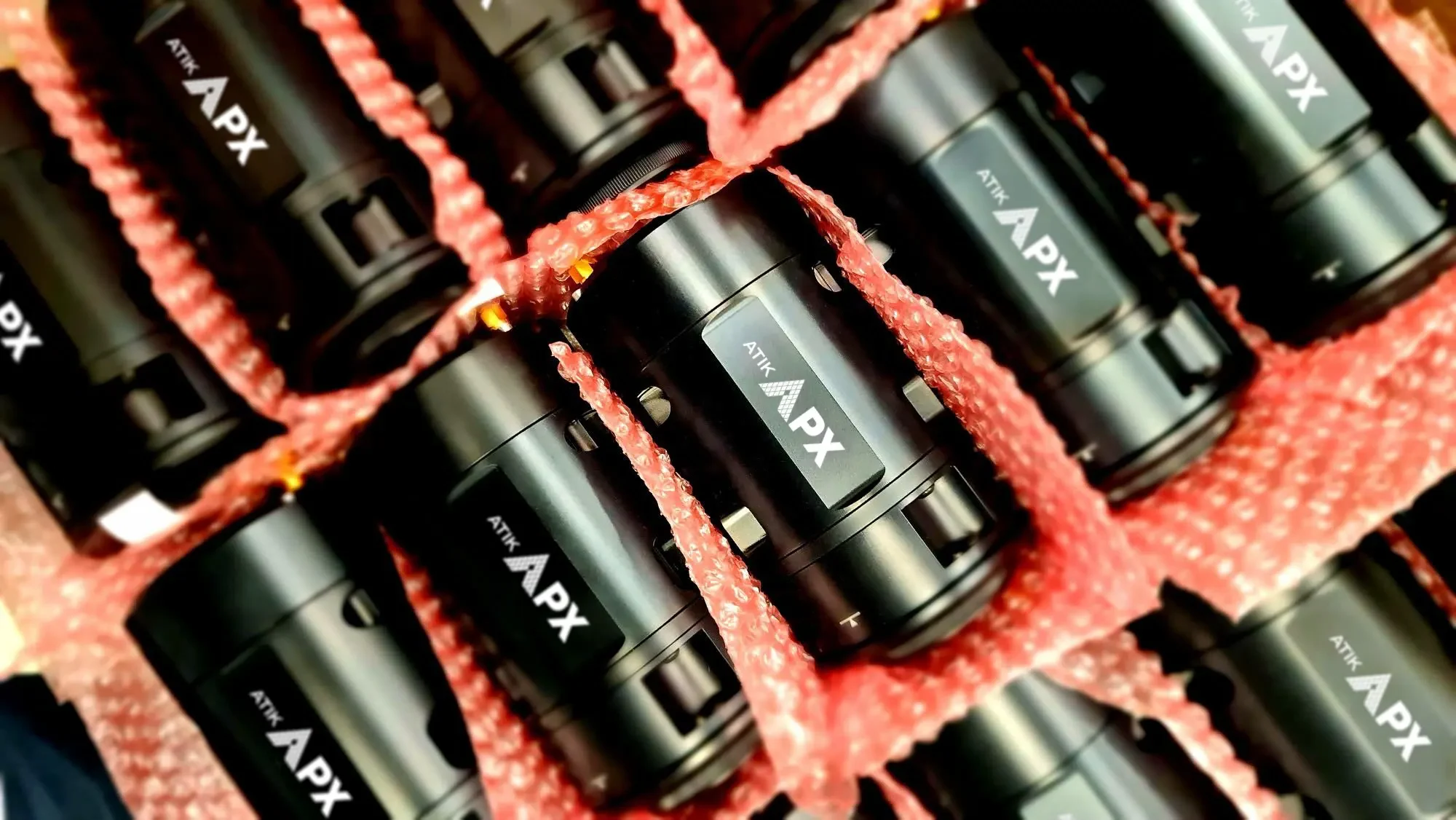
The Space-ready repackaging – Deconstruction and vacuum adaptations
The transition from a ground-based astronomical camera to a space instrument required a radical deconstruction of the standard Atik apx60. To facilitate rapid prototyping and evaluation, Atik initially supplied a fully packaged unit, allowing the Berkeley team to identify the essential architecture needed for the mission. Demonstrating exceptional engineering flexibility, Atik then pivoted from a standard product delivery to a customized board-level solution, providing only the core PCB stack to meet the payload’s stringent volume and vacuum constraints.
From COTS to a custom PCB stack
To achieve the necessary customization, the Apx60 was stripped to its essential “CuRIOS model” components: the Detector Board, FPGA Board, and Power Board. These boards were maintained as a mechanical and electrical “stack,” utilizing the original board-to-board connectors and standoffs to ensure structural integrity.
To adapt the system for the vacuum of space and the limited 1U x 2U payload volume (10 cm x 10 cm x 20 cm) of the InspireSat 12U bus, several modifications were implemented:
Thermal and mechanical removals
The external metal casing, cooling fan, Peltier cooler, and radiator were entirely removed. This was necessary not only to fit the final electronics into a compact 8 cm x 8 cm x 5 cm volume but also to eliminate components that are mechanically or electrically incompatible with high-vacuum operations.
Vacuum compatibility & Outgassing control
A critical technical requirement was the elimination of any materials prone to outgassing in low-vacuum environments (1e- 6 Torr), which could contaminate the detector or the vacuum chamber. Consequently, all non-vacuum-certified staking glues and adhesives typically used on screws and standoffs were removed or replaced.
Interconnect optimization
The ribbon cables connecting the Power and FPGA boards to the Detector Board were shortened to a minimum of 5.5 cm. This modification was essential to constrain the system’s volume and position the electronics stack as close to the detector as possible, effectively reducing potential electronic noise in the signal path.
This collaborative process allowed Berkeley to leverage Atik’s high-performance electronics while integrating them into a custom interface plate and a Simera xScape100 Schmidt-Cassegrain optical front-end. This flexibility highlights Atik’s capability to provide board-level solutions for partners requiring deep hardware integration for extreme environments.
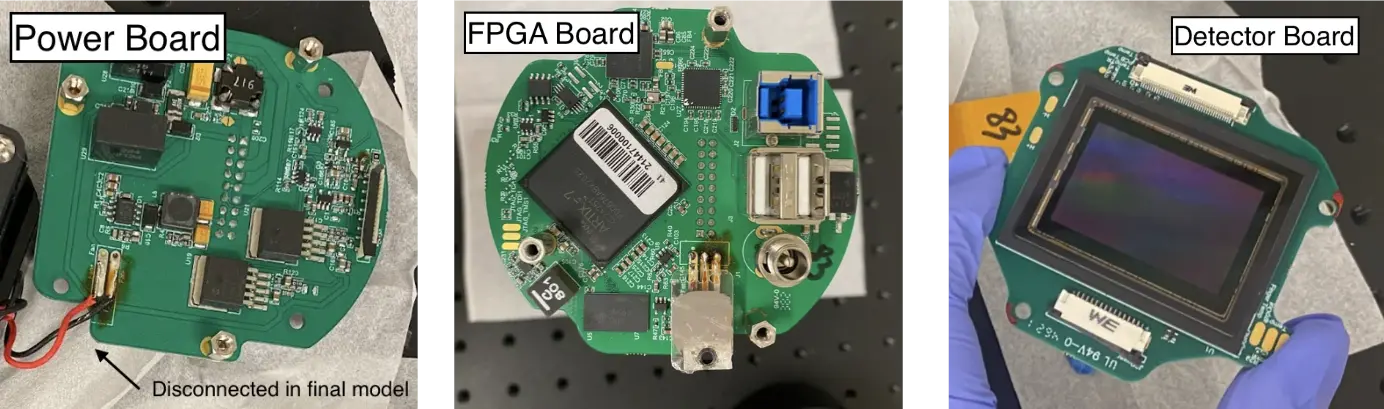
Modifications made on the Apx 60 components
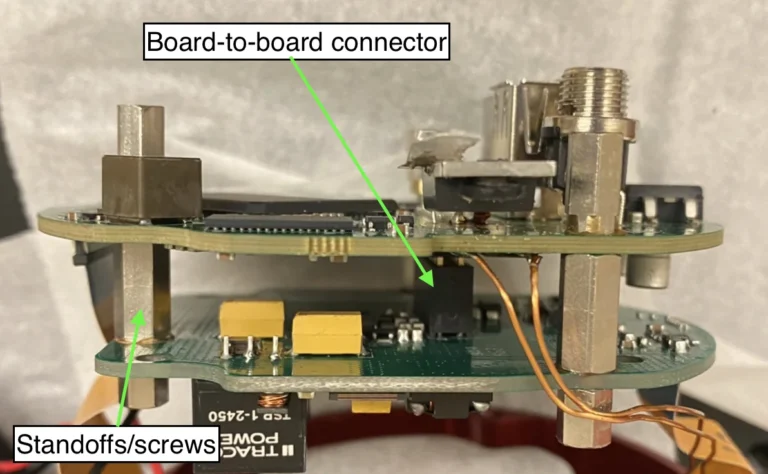
FPGA and Power Board Stack
The Atik engineering edge – Hardware optimizations for LEO environments
Beyond providing a high-performance imaging platform, Atik Cameras served as a strategic engineering partner, implementing hardware-level optimizations essential for a successful orbital mission. These highlights define why the Atik electronics are uniquely suited for the rigors of space:
Automotive-Grade electronics optimization
To ensure the robustness required for survival in the harsh conditions of Low Earth Orbit (LEO), Atik utilized and optimized automotive-grade electronics. This choice provides a significantly higher level of reliability and stability compared to standard consumer-grade components, making the platform resilient against the temperature fluctuations and structural stresses of a satellite launch and operation.
Continuous telemetry via system monitor module
A critical requirement for any satellite payload is the ability to monitor “state of health” in real-time. Atik implemented a custom system monitor module within the FPGA architecture. This module returns precise data on the various voltages of the FPGA, enabling continuous telemetry and allowing mission control to monitor the electronic stability of the camera system throughout its mission life.
Maximizing Sony sensor potential
While the Sony IMX455 is a world-class detector, its performance is ultimately dictated by the quality of the readout electronics. Atik’s engineers have fine-tuned the Apx60 platform to extract the absolute maximum potential from the sensor.
This combination of ruggedized hardware, integrated telemetry, and vacuum-optimized manufacturing underscores Atik’s expertise in delivering scientific-grade precision within the stringent volume and thermal constraints of modern CubeSat architectures.
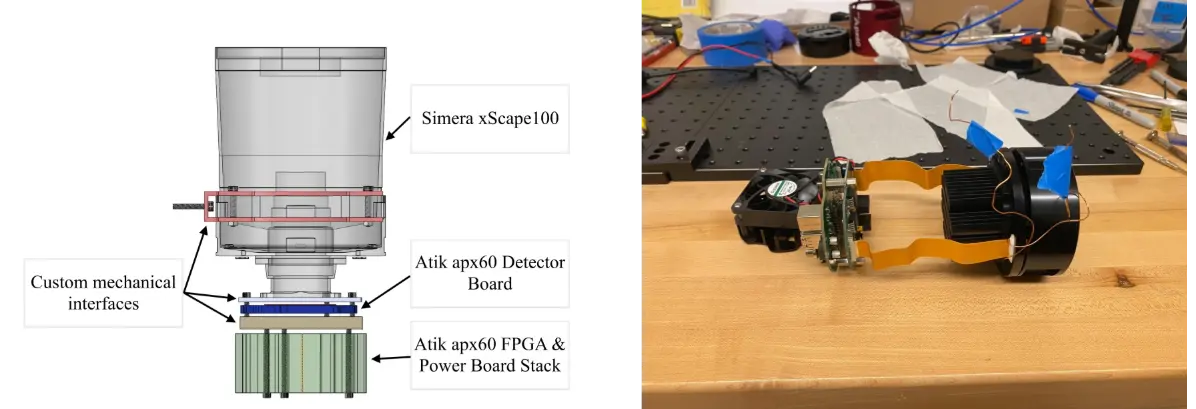
The CuRIOS-ED payload | Rough Approximation of CuRIOS Model
Results and performance
Engineering validation
The transition from a commercial imaging system to a space-qualified instrument was validated through rigorous environmental and performance characterization. The repackaged Atik Apx60 demonstrated that its core electronics could not only survive but also excel under the extreme conditions required for orbital deployment.
Proven resistance in extreme environments
The modified camera electronics successfully completed a series of Thermal Vacuum (TVAC) tests, proving their resilience in a high-vacuum environment with pressures reaching 1e-6 Torr. The system was subjected to four days of thermal cycling, operating without failure across an extreme temperature range from -35 °C to 40 °C. This validation confirms the hardware’s ability to withstand the intense thermal gradients and lack of atmospheric cooling characteristic of Low Earth Orbit (LEO).
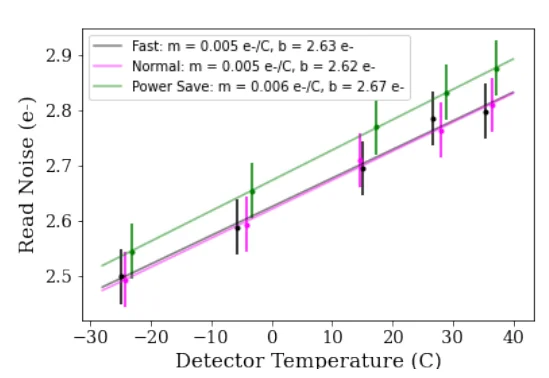
Read noise as a function of detector temperature in TVAC testing
Exceptional performance
Baseline characterization revealed an exceptionally low read noise of 2.43 ± 0.05 e- at a gain of 1 electron/ADU. Furthermore, the dark current remained negligible (well below 1 e-) across the tested temperatures and exposure times, ensuring high-fidelity data for long-duration science integration.
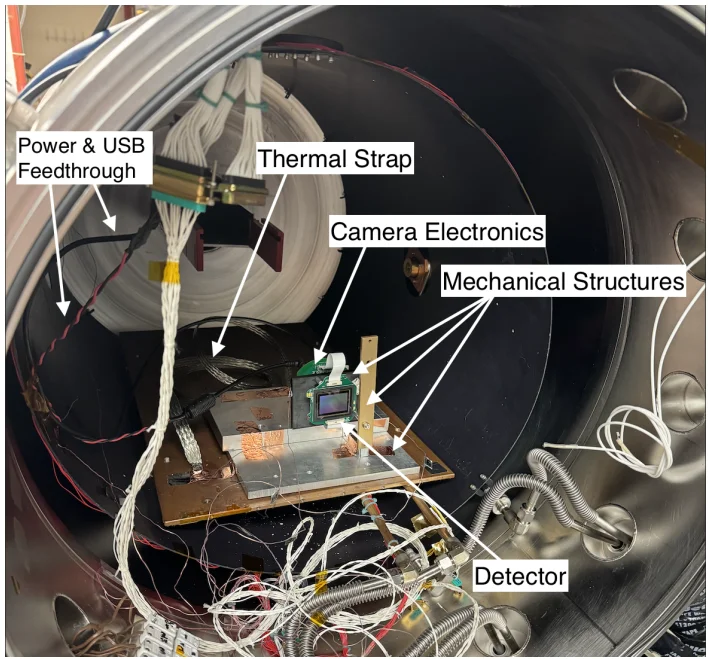
TVAC testing setup

1. Distribution of the read noises in all 61 MP of the Apx60 camera with Sony IMX455 detector for exposure times of 0.001, 0.01, 0.1, 1, 5, 10, 15, and 30 seconds
2. Read noise as a function of detector temperature at low gain = 1
3. The mean pixel value over an image versus the exposure time
Mission-critical reliability
A key milestone of the engineering process was demonstrating that the camera returned to nominal operations and maintained its original detector characteristics after undergoing aggressive thermal stress, demonstrating that the camera returned to nominal operations, with read noise values (2.62 ± 0.05 e− at 0°C) remaining consistent with baseline characterization after undergoing aggressive thermal cycling between -35°C and 40 °C.
This long-term stability is critical for the CuRIOS-ED mission’s goal of providing precise and stable photometry for the study of black holes and neutron stars.
| Category | Parameter | Value / Specification |
| Performance data | Read Noise (Baseline) | 2.43 ± 0.05 e− (at Gain 1 e−/ADU) |
| Read Noise (TVAC @ 0°C) | 2.62 ± 0.05 e− | |
| Dark Current (< 1s) | Negligible | |
| Dark Current (> 1s) | < 1 e−/s (0.04 e−/s at 19°C) | |
| Electronics Noise Floor | 2 – 3 e− (temperature dependent) | |
| Environmental Resilience | TVAC Operating Range | -35 °C to +40 °C |
| TVAC Vacuum Level | 10−6 Torr (tested down to 5×10⁻⁷ Torr) | |
| Material Compliance | Vacuum-certified (Low-outgassing glues/adhesives) | |
| Component Reliability | Optimized Automotive Grade | |
| System Features | Form Factor (Repackaged) | 8 cm x 8 cm x 5 cm |
| System Telemetry | Real-time FPGA Voltage Monitoring | |
| Exposure Modes | Normal, Fast, Power Save (via Atik SDK) |
Conclusion
The success of the CuRIOS-ED mission is a testament to the power of a deep engineering partnership. Atik Cameras provided comprehensive joint technical support, collaborating closely with the UC Berkeley team to adapt the Apx60 for the unique and uncompromising demands of a satellite payload. By assisting in the implementation of the project, from providing a customized board-level solution to implementing critical telemetry for system health, Atik demonstrated its agility in supporting mission-critical scientific goals.
The successful space –qualification of the repackaged Apx60 is a significant milestone. The electronics not only survived extreme Thermal Vacuum (TVAC) cycling between -35 °C and 40 °C but also returned to nominal operations without any degradation in detector performance. This validation proves that Atik’s high-performance electronics are robust enough to deliver scientific-grade data from the most extreme environments.
As CuRIOS-ED prepares for its mid 2027 launch, it serves as the essential foundational proof for the future CuRIOS constellation. The roadmap for this project envisions a network of approximately 300 CubeSats providing continuous, all-sky observations of the transient universe. By successfully qualifying a commercial-off-the-shelf (COTS) solution for space, Atik and Berkeley have demonstrated a path to reducing mission costs by a factor of 100x, paving the way for a new era of scalable, high-cadence orbital surveys and Space Domain Awareness.
References
CuRIOS-ED: The Technology Demonstrator for the CubeSats for Rapid Infrared and Optical Surveys Mission: https://arxiv.org/abs/2409.11471
