 Skip to main content
Atik Horizon Series – The Atik Legacy
The Atik Horizon Series holds a pioneering place in Atik Cameras history as our very first cooled CMOS camera line. Mechanically adapted from our successful 4-Series cylindrical body, the Horizon was engineered from the ground up to adapt modern CMOS technology for high-performance deep-sky astrophotography. Offering an impressive 16-megapixel array across a 4/3” sensor diagonal, this series offered an unbeatable cost-per-pixel ratio, making it a favorite choice for imagers upgrading from DSLR cameras or seeking fast readout speeds for near-real-time sky viewing.

The Horizon Series goal
While CCD sensors long dominated long-exposure imaging, CMOS technology introduced exceptionally low read noise (~1e- at high gain) and rapid readout speeds. The primary goal of the Horizon Series was to bridge these CMOS advantages with Atik’s signature precision cooling and robust build quality.
By implementing an upgraded cooling system capable of reaching 40°C below ambient and integrating a built-in 256MB DDR III image buffer, the Horizon Series reduced frame loss and amplifier glow issues often associated with early CMOS entries. The result was a versatile imaging system equally adept at fine deep-sky capture and near-real-time video astronomy.
Models: the Atik Horizon Series lineup
The Horizon Series comprised two distinct iterations, each refining the capabilities of the 4/3″ 16-megapixel CMOS platform
Atik Horizon I
The Atik Horizon I marked a historical milestone as Atik’s inaugural step into CMOS astrophotography. Built around a 16-megapixel 4/3″ CMOS sensor featuring a 4644 x 3506 resolution and small 3.8µm pixels, it was engineered from the ground up to bring exceptionally low read noise (~1e- at high gain settings) to deep-sky imaging. Adapting the cylindrical 60mm-class body design from our successful 4-Series, the Horizon I offered native physical compatibility with HyperStar and Fastar systems from 8” upwards, ensuring minimal central obstruction in front of Schmidt-Cassegrain telescopes while delivering an expansive field of view on fast refractors.
To maintain pristine image quality across long integration times, the camera featured high-efficiency regulated thermoelectric cooling capable of reaching up to 40°C below ambient. It was equipped with an onboard 256MB DDR III image buffer to ensure smooth data transfer over USB 3.0 or USB 2.0 connections without dropping frames. Furthermore, the Horizon I was the first camera outside the Infinity line to feature native compatibility with both our traditional Artemis Capture control suite and our intuitive Atik Infinity application, allowing imagers to seamlessly transition between deep-sky long exposures and near-real-time live-stacking visual astronomy.
Download the Atik Horizon I User Manual
Atik Horizon II
Building directly on the success of the original model, the Atik Horizon II introduced upgraded low-noise electronics and enhanced temporal noise immunity to give astrophotographers unprecedented control over data acquisition. It retained the celebrated 16-megapixel 4/3″ CMOS sensor with its fine 3.8µm pixel architecture and 21.9mm diagonal, offering an impressive cost-per-pixel ratio, while elevating the hardware performance to handle both high-resolution deep-sky imaging and high-speed planetary capture.
The defining feature of the Horizon II was the introduction of three distinct operational modes: PowerSave mode, designed to deliver maximum dynamic range and clean signal for deep-space exposures; Fast mode, capable of driving full-frame readouts at 8 FPS; and subframing mode, pushing acquisition speeds up to 100 FPS for lucky imaging techniques. Supported by the signature -40°C cooling delta, a 256MB DDR III memory buffer, and full integration across Atik’s software ecosystem, the Horizon II established itself as one of the most versatile CMOS cameras in its class.
Download the Atik Horizon II User Manual
Atik Horizon Series Specifications
| Specification | Atik Horizon I | Atik Horizon II |
| Electronics Architecture | First-generation Atik CMOS control circuitry | Upgraded low-noise electronics with improved temporal noise immunity |
| Operational Modes | Standard readout mode | 3 Selectable Modes: PowerSave, Fast, and Subframing |
| Full-Frame Readout Speed | Standard frame rate | 8 FPS (Fast Mode) |
| High-Speed Subframing (ROI) | N/A | Up to 100 FPS (Lucky Imaging) |
| Primary Target Applications | Deep-sky imaging & near-real-time EAV | Dual-purpose: Deep-sky long exposures & high-speed planetary/lunar imaging |
| Readout Noise (Typ.) | ~1e⁻ (at ×30 gain) | ~1e⁻ (with improved temporal noise immunity) |
| Full Well Capacity | ~20,000 e⁻ | |
| Cooling Delta | -40°C below ambient (Regulated) | |
| Operational Modes & FPS | Full-frame readout | PowerSave, Fast Mode (8 FPS full-frame), Subframing (up to 100 FPS) |
| Onboard Buffer | 256 MB DDR III | |
| Exposure Range | 18 µs to Unlimited | |
| PC Interface | USB 2.0 / USB 3.0 | |
| Backfocus Distance | 13 mm ±0.5 | |
| Front Thread | M42 × 0.75 (T-mount) | |
| Power Requirements | 12VDC, 2A | |
| Weight | 525 g | |
| Variants | Mono or Color | |
History and Technical Applications: Atik Horizon Legacy Cameras

The technical authority of the Horizon Series was defined by its dual-purpose flexibility. It was the first camera outside the Atik Infinity line to feature native compatibility with our Infinity live-viewing software, allowing astronomers to go “from sky to screen in seconds” during public outreach or observational sessions.
Beyond visual astronomy and deep-sky astrophotography, the Horizon’s high resolution, regulated thermal control (-40°C delta), and low read noise made it a reliable platform for scientific applications, light-microscopy, and OEM laboratory setups where cost-effective large-area imaging was required.
The end of the Series
The conclusion of the Horizon Series marked the completion of Atik’s initial transition into CMOS technology. As sensor architectures evolved with back-illuminated (BSI) designs and native 16-bit digitisation, the Horizon paved the way for our modern CMOS camera families.
Although discontinued, Horizon cameras remain highly active in observatories worldwide. Atik Cameras continues to support legacy Horizon users through our Universal Core Software installer, ASCOM drivers, and our dedicated Dusk and Infinity imaging suites.
Current Series Correlation: Upgrading to the Apx Series
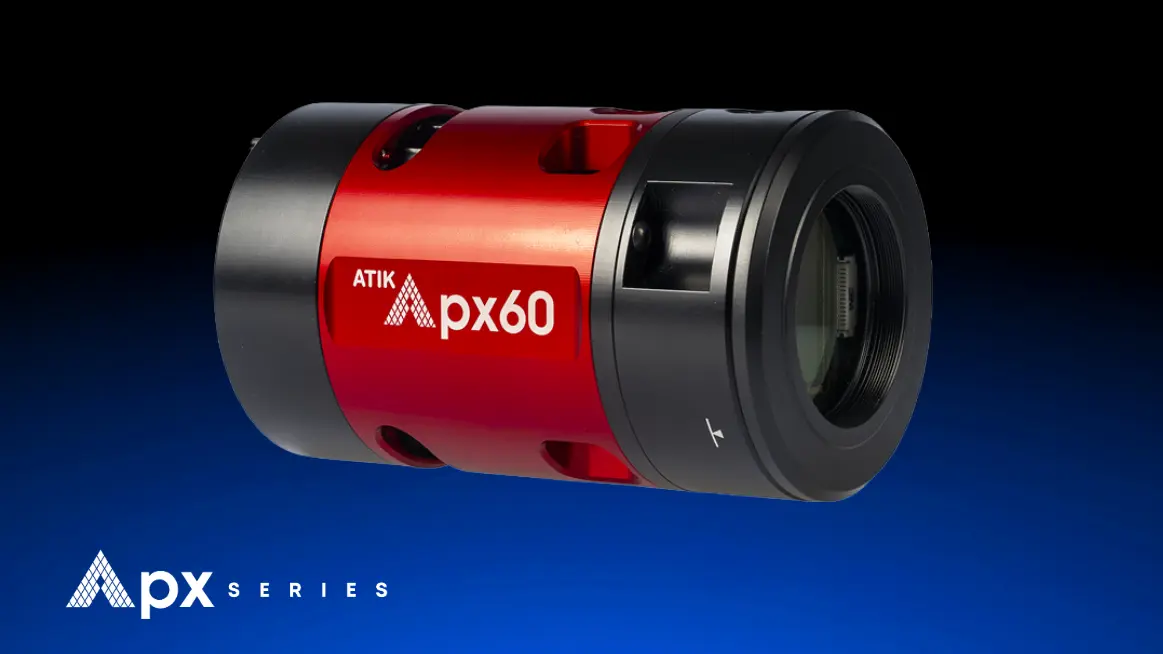
The modern successor for users transitioning from the Atik Horizon Series is the Atik Apx Series (featuring the Apx26 and Apx60). While the Horizon marked Atik’s pioneering step into CMOS astrophotography, the Apx Series represents the current benchmark for professional 16-bit CMOS imaging.
Upgrading from the Horizon to the Apx Series introduces several major performance enhancements:
- Native 16-Bit Dynamic Range: Moving from the Horizon’s 12-bit ADC to the native 16-bit digital-to-analog conversion of the Apx Series provides significantly greater dynamic range and smoother tonal transitions in deep-sky targets.
- Zero Amp Glow & Ultra-Low Noise: Powered by Sony’s back-illuminated CMOS architecture, the Sony IMX571 (APS-C) in the Apx26 and Sony IMX455 (Full-Frame) in the Apx60, the Apx range completely eliminates amp glow while lowering read noise to an astonishing 1.4 e⁻ in High Gain Mode.
- Expansive Field Coverage: Compared to the 4/3 format of the Horizon, the larger sensor diagonals (28.3mm on the Apx26 and 43.3mm on the Apx60) deliver vast sky coverage, making them ideal for wide-field nebulae, galaxy clusters, and Space Domain Awareness (SDA).
Frequently asked questions (FAQ)
Is the Atik Horizon Series compatible with Windows 10 and 11?
Yes. Both the Horizon I and Horizon II are fully supported by our current Universal Core Software installer and ASCOM drivers, ensuring full compatibility with modern acquisition suites like NINA, Sequence Generator Pro, and Voyager.
Can I use the Atik Horizon on a HyperStar system?
Yes. The Horizon’s cylindrical body design was specifically engineered to be compatible with HyperStar and Fastar systems from 8” and above, keeping obstruction in front of the telescope light path to a minimum..
Does Atik still provide still repairs and support for the Horizon Series?
Atik Cameras remains committed to assisting our community of users. However, please note that support and repair services for legacy series are limited and evaluated on a case-by-case basis depending on component availability. If you experience technical challenges with your unit, please get in touch with our Technical Support team.
Need more information?Contact the technical support
We are here to help you get the best performance from your Atik cameras. If you are experiencing technical challenges with your Large Format Series Camera setup or have specific questions about software compatibility, our specialized support team is ready to provide expert guidance: contact our technical support.
