 Skip to main content
Sony IMX571 Sensor: Complete Technical Guide
As a scientific CMOS sensor, the Sony IMX571 has become a reference in demanding imaging applications, with adoption across astronomy, industrial inspection, and research. This guide covers its technical specifications, performance characteristics, and how the XGbE-26 camera implements it for professional use.
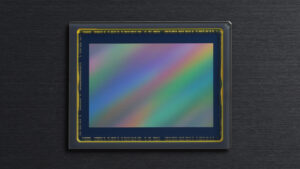
Sensor architecture
A 26.11-megapixel back-illuminated CMOS sensor in an APS-C format (Type 1.8, 28.3mm diagonal), the IMX571 repositions the photodiode layer closer to the incident light surface, with readout circuitry moved to the rear of the substrate.¹ This is a back-illuminated architecture that increases light-gathering efficiency and full-well capacity compared to front-illuminated designs of similar pixel pitch. And that’s a key reason why it has become a preferred choice in scientific CMOS camera systems.²
Resolution and format
| Parameter | Value |
| Effective pixels | 6252 × 4176 (26.11 MP) |
| Total pixels | 6280 × 4264 (26.78 MP) |
| Active imaging area | 23.5mm × 15.7mm |
| Pixel size | 3.76μm × 3.76μm |
Readout and interface
- Native 16-bit analog-to-digital conversion³
- Maximum frame rate: 6.84 fps at full resolution (16-bit mode)³
- Supported output depths: 10-bit, 12-bit, 14-bit, 16-bit
- Built-in programmable gain amplifier (PGA), up to 36dB³
- 8-lane SLVS-EC output interface
- Rolling shutter operation⁴
- RGB Bayer color filter array (color variant)
Performance
Quantum efficiency
Peak quantum efficiency exceeds 80% in the green channel, with strong response across the 400–700nm visible range. Red-channel QE remains above 60% through 650nm, dropping gradually toward the near-infrared — relevant for H-alpha imaging at 656nm, where the sensor retains usable sensitivity without modification. Compared to front-illuminated CMOS sensors of similar pixel pitch, the BSI architecture improves the sensitivity and efficiency while full-well is dependent of the photodiode architecture.
Dynamic range and bit depth
Native 16-bit ADC resolves 65,536 discrete levels. Sensors that interpolate 12-bit or 14-bit data to 16-bit output introduce quantization artifacts at the low end of the signal range – an issue the IMX571 avoids by design. For photometric work – variable star analysis, exoplanet transit detection, radiometric calibration – this preserves subtle signal gradations throughout the imaging chain.
Gain modes, linearity, and calibration
Two primary gain modes define the sensor’s operating envelope. High gain mode achieves read noise as low as 1.2 e-, optimizing for faint-signal detection where photon shot noise dominates. Low gain mode raises read noise to approximately 3.6 e- while increasing full-well capacity, extending dynamic range for brighter targets.
Linearity across both modes is well-characterized, which matters for any calibration-dependent workflow. Flat-field and dark frames taken in one gain mode are not interchangeable with the other, so calibration libraries should be built per mode. For automated pipelines, consistent gain selection at the start of each session prevents systematic calibration errors.
Full-well capacity
Despite a 3.76μm pixel pitch, full-well capacity exceeds 50,000 electrons – and in some optimized readout implementations, goes above 70,000 electrons. In practice, this means wider intra-frame dynamic range, reduced blooming in high-contrast scenes, and better tolerance for mixed illumination conditions.
Dark Current and Thermal Behavior
Dark current is strongly temperature-dependent. At -20°C, optimized systems achieve levels as low as 0.0005 e-/pixel/second – negligible across multi-hour exposures. This behavior makes the sensor well-suited for:
- Extended astrophotography integrations
- Time-lapse sequences requiring consistent frame characteristics
- Quantitative experiments with repeatable conditions
- Industrial inspection with long integration times
Atik CMOS Camera Implementations: Apx26 & XGbE-26
Atik integrates the Sony IMX571 sensor into two distinct camera platforms, each engineered for a specific system architecture and deployment scenario: the Apx26 for direct USB 3.0 host integration and deep-cooled scientific imaging, and the XGbE-26 for network-addressable 10 GbE multi-camera clusters.
Atik XGbE-26: Network-Addressable 10 GbE Imaging Platform
The XGbE-26 adapts the Sony IMX571 sensor into a native 10 GbE IP device, specifically engineered for high-density multi-camera clusters and distributed observation networks where USB bandwidth, range limits, and host-cabling overhead become system bottlene

Scalable cluster architecture & high-density deployment
Operating as an independent network device over a dedicated 10 Gb/s SFP+ link, the XGbE-26 streams uncompressed 16-bit frames at up to 6.82 fps at full resolution. Because its 26.11 MP APS-C format produces optimized file sizes, an aggregating switch can consolidate a higher camera density per server over a 100 Gb/s QSFP uplink compared to full-frame alternatives. For mission-critical installations, multi-server support provides automatic failover protection, ensuring continuous data acquisition to redundant backup servers if a primary host goes offline.
GPS synchronization & triggerless timing precision
For distributed Space Domain Awareness and multi-telescope arrays, the XGbE-26 integrates GPS reference timing paired with sub-1 millisecond (<1 ms) frame-level temporal alignment across every camera in a cluster. By distributing clock signals digitally over the Ethernet backbone, it completely eliminates physical hardware trigger cabling between units, significantly reducing installation complexity and maintenance overhead in large-scale deployments
Advanced thermal management & liquid-cooled options
Maintaining a cooling capacity of 35°C below ambient (reducing dark current to ~0.0008 e⁻/pixel/second at -15°C), the XGbE-26 is offered in both air-cooled and liquid-cooled configurations. The liquid-cooled variant is designed specifically for sealed enclosures or ambient-sensitive environments where maintaining strict sensor thermal control and preventing heat dissipation into surrounding optics is critical to data fidelity. Additionally, the platform features integrated LED status signaling for rapid visual diagnostic alerts across dense camera grids, and operates seamlessly alongside the full-frame XGbE-60 within the same synchronized cluster.
The XGbE-26 is Atik’s network-native IMX571 camera platform, available in monochrome and color.
View the XGbE-26 | Download the datasheet | Contact Atik
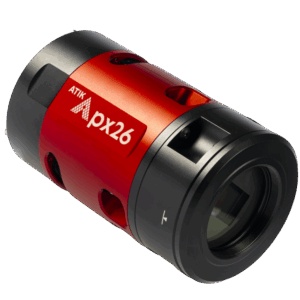
Atik Apx26: CMOS camera implementation
Atik’s Apx26 is a scientific CMOS camera built around the IMX571 in both monochrome and color configurations, with engineering focused on thermal management, readout fidelity, and system integration.
Thermal management
A thermoelectric cooling system stabilizes sensor temperature at 35°C below ambient. During typical operation, this places the sensor in the -15°C to -20°C range, where dark current falls below 0.001 e-/pixel/second. Temperature is actively regulated rather than just reduced, ensuring consistent sensor characteristics across sessions – important for automated inspection systems and any workflow relying on pre-characterized calibration frames.
Anti-condensation optics and sealed construction maintain optical clarity in variable environments, while anti-reflection coatings on the optical window minimize internal reflections in high-contrast scenes.
Readout architecture
At full 26-megapixel resolution with 16-bit depth, the Apx26 runs at 4 fps. A 512MB onboard buffer prevents frame drops during sustained acquisition, independent of temporary host system load.
Available readout modes:
- Full resolution – 6244 × 4168 px at 16-bit, for applications requiring maximum spatial and tonal detail
- Windowed readout – frame rates above 100 fps at 2K resolution, for motion analysis or transient event capture
- Variable gain – multiple gain settings to match signal levels across use cases, from bright-field microscopy to low-light astronomical targets
Connectivity and mechanical integration
USB 3.0 (5 Gbps) handles data transfer, with an integrated hub for peripherals such as guide cameras and filter wheels. Optical coupling is M54 × 0.75mm threading, with a 17.5mm sensor-to-flange distance. Adjustable sensor mounting enables precise focal plane alignment – critical in applications requiring exact field correction across the full imaging area.
The Apx26 is Atik’s IMX571-based scientific CMOS camera, available in monochrome and color.
View the Apx26 | Download the datasheet | Contact Atik
Application areas
Astronomy and space surveillance
The APS-C format and 3.76μm pixel pitch pair well with fast astrograph systems in the f/2.8–f/5 range, achieving good sampling under typical seeing conditions. Low read noise makes narrowband imaging practical where per-frame signal levels are inherently low, and QE at H-alpha (656nm) supports emission-line imaging without sensor modification.
For quantitative work, native 16-bit output and good linearity support photometric measurements precise enough for variable star and transit studies. Resolution and readout speed together enable transient detection and asteroid tracking – applications where this CMOS technology offers a meaningful advantage over earlier CCD-based systems.
Industrial inspection
At 26 megapixels, large inspection areas can be covered without sacrificing defect detection resolution, reducing the number of imaging positions needed for large-part inspection. In color configuration, 16-bit processing provides sufficient discrimination for classification tasks based on subtle hue or saturation differences. Temperature-stabilized operation ensures consistent calibration over long production runs.
Satellite tracking and Defense
High sensitivity enables detection of faint objects against sky background, while the large format supports accurate positional measurements from single frames for orbit determination. Extended integration with low dark current is relevant for detecting small or distant debris objects in space domain awareness applications.
Life sciences and microscopy
Low read noise and extended integration capability make the sensor viable for weak fluorescence detection, where signal levels are often very low relative to background. The large format allows imaging of substantial specimen areas or multiple sample positions in a single frame — a practical advantage in high-content screening. For time-lapse studies, thermal stability over multi-hour or multi-day sequences prevents drift in calibration or color response. These characteristics are broadly representative of what makes scientific CMOS cameras preferable to legacy CCD systems in modern life science workflows.
IMX571 vs. related Sony sensors
| Specification | IMX571 | IMX455 | IMX533 | IMX174 |
| Resolution | 26.11 MP | 61 MP | 9 MP | 2.3 MP |
| Effective pixels | 6252 × 4176 | 9504 × 6480 | 3008 × 3008 | 1920 × 1200 |
| Pixel size | 3.76 μm | 3.45 μm | 3.76 μm | 5.86 μm |
| Sensor format | APS-C (Type 1.8) (optical format not photographic format) | Full Frame (Type 2.4) | Micro Four Thirds | 1/1.2″ |
| Diagonal | 28.3 mm | 43.3 mm | 16.0 mm | 15.9 mm |
| Max frame rate | 6.84 fps | 3.76 fps | 120 fps | 164 fps |
| Key advantage | Full-well capacity, low-light performance | Highest resolution | Fast readout, compact | High frame rate |
| Trade-off | Moderate frame rate | Slowest readout, smallest pixels | Lower resolution | Lowest resolution |
- The IMX455 offers higher pixel count but at smaller 3.45μm pixels, reducing per-pixel full-well capacity and slightly lowering peak QE.
- The IMX533 shares the same pixel architecture and pitch as the IMX571 but in a smaller, faster format — better suited when sensor footprint or frame rate matters more than resolution.
- With its larger 5.86μm pixels, the IMX174 delivers better per-pixel sensitivity at the cost of total pixel count, serving high-frame-rate applications where resolution is secondary.
Implementing the IMX571
Before deploying an IMX571-based CMOS camera system, a few parameters are worth defining early:
- Resolution vs. frame rate – Full 26-megapixel readout at 4 fps suits static or slow-moving subjects. Windowed modes trade resolution for speed, and binning offers a middle ground for applications that fall between those extremes.
- Monochrome vs. color – The monochrome variant, paired with a filter wheel, gives more flexibility for multispectral or narrowband imaging. Each filter pass captures 100% of available pixels at the target wavelength, versus the 25–50% captured by equivalent Bayer channels in a color sensor. For narrowband or fluorescence work, monochrome is generally the better choice. Color sensors simplify RGB acquisition and remove filter wheel overhead, with the trade-off being lower per-channel sensitivity.
- Gain mode selection – High gain suits faint-signal applications; low gain is preferable for high-dynamic-range scenes. Calibration frames must match the gain mode used for science frames, so establishing a consistent workflow early simplifies library management.
- Thermal and power requirements – Active cooling requires a stable power supply (12VDC, 5A for the Apx26) and adequate thermal headroom in the installation environment. Sealed optics handle most ambient conditions, but this should be factored into field deployments.
- Data handling – At full resolution and 16-bit depth, sustained acquisition generates significant throughput. Storage and processing pipelines should be sized before deployment.
Frequently Asked Questions
What is the IMX571’s read noise at different gain settings? High gain mode achieves read noise as low as 1.2 e-, optimized for faint-signal detection. Low gain mode sits at approximately 3.6 e- with higher full-well capacity. The right choice depends on whether dynamic range or sensitivity is the limiting factor for a given application.
Does the IMX571 support global shutter? No, it uses an electronic rolling shutter. For most astronomy, SDA, or inspection use cases involving stationary or slow-moving subjects, this is not a limiting factor.
Can calibration frames be reused across sessions with the Apx26? Yes, provided sensor temperature is consistent. Active thermoelectric regulation holds temperature to a fixed setpoint, so dark frames taken at the same temperature and exposure duration remain valid across sessions. Flat fields should be retaken whenever the optical train changes.
How does the IMX571 compare to the IMX455 for low-light imaging? Larger pixel area (3.76μm vs. 3.45μm) gives the IMX571 a slight full-well capacity advantage per pixel. Both sensors use back-illuminated architecture with similar peak QE. Where total photon collection per pixel matters more than field coverage, the IMX571 is marginally better. For maximum spatial resolution across a large field, the IMX455’s higher pixel count is the deciding factor.
Is the Apx26 compatible with standard astronomy software? Yes. The camera is ASCOM-compatible on Windows and supported by major acquisition platforms including Sequence Generator Pro, N.I.N.A., and Prism. FITS output is standard. An SDK is available for direct integration into custom pipelines for industrial and scientific applications.
What are the data rate requirements for the Apx26? At full resolution and 16-bit depth, a single frame is approximately 52MB. At 4 fps, sustained throughput is around 208 MB/s — within USB 3.0 capacity, but requiring a storage or processing system rated for that rate. The 512MB onboard buffer absorbs short-term bottlenecks without frame loss.
Can the Apx26 be used in observatory automation or temperature-controlled enclosures? Yes. USB interface supports remote operation, and the camera integrates with standard observatory automation platforms. The thermoelectric cooling system maintains its setpoint independently of ambient temperature within its rated range (35°C below ambient), making it suitable for outdoor or semi-controlled enclosures.
Conclusion
Occupying a well-defined position in the scientific CMOS camera market, the IMX571 offers APS-C format, native 16-bit depth, back-illuminated architecture, and a pixel size that balances resolution with per-pixel sensitivity. It is not the fastest sensor available, nor the highest resolution, but for applications where signal fidelity and low-noise extended integration are the primary requirements, the specifications are well matched.
The Atik Apx26 translates those sensor capabilities into a deployable CMOS camera system with active thermal management, a robust mechanical interface, and broad software compatibility. For engineers and researchers evaluating imaging systems for astronomy, inspection, or life sciences, the IMX571 platform is a practical starting point that addresses most acquisition requirements without compromise.
Explore the Atik Apx26
The Apx26 is available in monochrome and color configurations. Full specifications, pricing, and ordering information are on the product page. If you’d like to discuss your application or imaging requirements, the Atik team is happy to help.
View the Apx26 product page | Download the datasheet | Contact Atik
Sources
