 Skip to main content
Sony IMX CMOS sensors: a practical comparison guide
Choosing a Sony IMX sensor is not as simple as reading down a spec sheet. The IMX portfolio spans global shutter and rolling shutter designs, pixel sizes from 2.74 µm to 5.86 µm, formats from compact industrial chips to full-frame scientific arrays, and resolution ranges from 2 megapixels to over 100. “IMX” on the label tells you very little on its own.¹
This guide is Atik Cameras’ take on that landscape, focused on the parts of the Sony IMX sensor list that matter most in practice. Rather than cataloguing every Sony IMX model in existence, the goal here is a working comparison that leads to a real decision.
The main split: global shutter vs rolling shutter
Before pixel size, resolution, or format, the first decision in any Sony CMOS sensor evaluation is shutter type, because it shapes everything else.
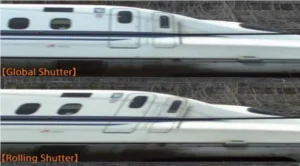
When you have a global shutter sensor, every pixel in the array exposes simultaneously, which eliminates the geometric distortion – skew, wobble, partial exposure – that rolling shutter readout introduces when subjects are moving quickly. That makes them the standard choice in machine vision, robotics, logistics, traffic imaging, and any production environment where motion timing cannot be compromised.²˒³
Rolling shutter sensors read out row by row, which creates those artefacts when the scene moves fast. In return, they open up larger formats, higher resolution at equivalent pixel pitch, and, combined with Sony’s back-illuminated structure, significantly better light-gathering efficiency. Sony positions its rolling shutter industrial lineup explicitly around low noise, high sensitivity, and a wide choice of sensor sizes.⁴˒⁵
In practice: if the subject moves fast and motion geometry matters, global shutter is usually the right foundation. If the scene is mostly static and image quality per frame is the priority – field coverage, sensitivity, low noise floor – then, rolling shutter gives you more flexibility.

Sony’s global shutter branches
Large pixels, proven motion capture: the 5.8 Series
Reliability and optical simplicity define this class. The 5.8 Series, including the IMX174 and IMX249, uses 5.86 µm pixels, which gives strong per-pixel sensitivity and straightforward lens requirements. These are not sensors chasing megapixel counts; they are sensors built for scenes where subjects move fast, lighting is variable, and resolution beyond 2–3 MP is not required.⁶
Barcode and parcel reading on fast logistics lines, traffic camera systems, and motion-heavy inspection all fit this profile: applications where distortion-free capture and consistent timing matter more than spatial detail.
Atik’s ACIS 2.4 is the natural fit here: a compact global shutter camera built around the IMX249 for users who need dependable motion capture without the complexity of higher-resolution systems.
Detail and speed in the same frame: the 4.5 Series
Not every inspection task needs the 5.8 Series’ simplicity, and not every one needs the 3.4 Series’ full resolution. The IMX428 occupies a useful middle position: 7.10 MP at 4.5 µm pixels, with Sony’s own material highlighting high sensitivity and low dark current for FA and ITS applications.⁷
PCB inspection, electronics assembly verification, and automated optical inspection often land here: tasks where you need meaningfully more spatial information than 2.3 MP provides, but still need clean global shutter behaviour and a manageable data load.
The Atik ACIS 7.1 is built around the IMX428 for exactly this space.
The mainstream Pregius workhorse: the 3.4 Series
Much of the practical machine-vision market runs on this family. The 3.4 Series, including IMX250, IMX252, IMX264, IMX265, and IMX304, is built around 3.45 µm pixels and covers resolutions from around 3 MP up to 12.37 MP with the IMX304. ²˒⁸˒⁹
At the high end of this branch, the IMX304 is what matters most for high-detail industrial work: 12.37 MP at a 17.6 mm diagonal, with full global shutter behaviour. Industrial metrology, surface inspection, print inspection, and fine-detail quality control all benefit from the extra resolution while still requiring distortion-free capture that rolling shutter can’t reliably provide.
ACIS 12.3, based on the IMX304, is Atik’s highest-detail global shutter option.
Where Sony’s global shutter is heading: Pregius S
Back-illuminated architecture and a smaller pixel: that is the headline of Pregius S. Sony pushed pixel size down to 2.74 µm while keeping global shutter behaviour, which changes what global shutter camera design can look like in practice.³
Higher resolution becomes achievable in smaller optical formats. Compact system design and rising resolution demands stop being a contradiction. Sony’s current 2.7 Series and 2.7 UHS Series cover roughly 5.1 MP to over 100 MP, with use cases ranging from high-resolution factory automation and web inspection to any application where smaller optics still matter as sensor resolution climbs.²˒³

Images by Sony
Sony’s rolling shutter large-format sensors
For scientific imaging, astronomy, life sciences, and inspection workflows where sensitivity and field coverage matter more than motion timing, Sony’s rolling shutter sensors are a fundamentally different proposition. Sony describes these as strong on low noise and high sensitivity, with back-illuminated structures on key models for improved light capture.⁴˒⁵
The IMX533, IMX571, and IMX455 – the three Sony IMX sensors that anchor Atik’s scientific camera range – all share the same 3.76 µm back-illuminated pixel architecture. Per-pixel noise performance is closely matched across all three. What varies is format, resolution, frame rate, and bit depth. Choosing between them is really a question of how much of the scene needs to fit in one frame, and how much data the rest of the system can handle.
Square format, compact science: IMX533
Symmetric subjects and symmetric sensors belong together. Unlike every other Sony IMX sensor in this family, the IMX533 has a 1:1 square aspect ratio: 9.07 MP, 15.968 mm diagonal, 3.76 µm pixels, 14-bit output.¹⁰ That square format is not a quirk; it is a functional advantage for applications where the illuminated image area is circular or symmetric. Microscope objectives, spectroscopic fibres, and integrating spheres all produce circular illumination patterns. Round subjects, like globular clusters, circular beam profiles or gel imaging fields, frame more efficiently without the unused corners that rectangular sensors produce.
The compact footprint reduces optics requirements and system cost. A lens or objective covering a 16 mm image circle covers this Sony CMOS sensor fully, which matters for OEM instrument integration where space and cost constraints are real.
The main limitation relative to the IMX571 and IMX455 is 14-bit maximum output rather than 16-bit. For most scientific workflows this is not a practical barrier: real-world dynamic range is limited by shot noise well before the ADC ceiling. But pipelines explicitly requiring native 16-bit data should use one of the larger sensors instead.
Atik has two IMX533-based cameras: the ChemiMOS 9, a cooled scientific camera designed for long-exposure life science and chemiluminescence workflows, and the C9, an OEM-configured variant for instrument integration where the compact square format is especially useful.
The APS-C all-rounder: IMX571
More field than the IMX533. Faster than the IMX455. Native 16-bit output. In the Sony IMX sensor comparison between the three rolling shutter models, the IMX571 consistently occupies the most versatile position.
Sony specifies it at 28.3 mm diagonal, 26.11 MP, 3.76 µm pixels, and 16-bit A/D conversion, with full-resolution readout at up to 6.84 fps.¹¹ Per-pixel noise characteristics are closely matched to the IMX455, sharing the same pixel pitch and BSI architecture. The practical difference is that the IMX571 covers less area per frame, but at nearly twice the frame rate and with a smaller, lighter optical system.
Wide-field microscopy, life science imaging where more sample area per frame is useful, long-exposure astronomy, and scientific inspection tasks all sit comfortably within what this Sony camera sensor can deliver. It is the sensor you reach for when APS-C coverage is genuinely sufficient and the additional cost and data burden of full frame is not justified.
At Atik, you can find the Apx26 and the 12K, both of them built around the IMX571. It’s actually one of the strongest and most versatile parts of the Atik lineup.
Maximum field coverage: IMX455
When one frame needs to contain as much of the scene as possible, the IMX455 is the answer. Full frame, 43.3 mm diagonal, 61.17 MP, 3.76 µm pixels, native 16-bit output — and full-resolution readout at around 3.97 fps.¹²
At any given focal length, this Sony CMOS camera sensor captures roughly 2.3 times the area of the IMX571. For wide-field astronomy, large-area microscopy, biological screening across entire well plates, or flat-object inspection where a single frame replaces multiple imaging positions, that field advantage is often the deciding factor in the entire system design.
The trade-offs are real and worth confronting early. Full-resolution 16-bit frames are approximately 116 MB each. Storage systems, processing pipelines, and network infrastructure all need to be validated for the sustained throughput before deployment. Optics must explicitly cover a 43.3 mm diagonal: any lens or corrector specified for APS-C will vignette meaningfully at the corners.
Atik’s Apx60 is the direct IMX455 implementation for scientific and astronomical work. The XGbE-60 is the networked variant for infrastructure-heavy deployment environments.
Sony IMX sensors compared
| Sensor / family | Shutter | Pixel size | Resolution | Format / diagonal | Main strengths | Use cases | Atik camera |
| IMX174 / IMX249 (5.8 Series) | Global | 5.86 µm | ~2.3 MP | Compact industrial | Proven motion capture, strong sensitivity, simple optics | Logistics, traffic, barcode reading, fast inspection | ACIS 2.4 |
| IMX428 (4.5 Series) | Global | 4.5 µm | 7.10 MP | 17.6 mm diagonal | Detail + speed balance, low dark current | PCB inspection, ITS, FA cameras, electronics verification | ACIS 7.1 |
| IMX250 / 252 / 264 / 265 (3.4 Series) | Global | 3.45 µm | ~3–5 MP | Classic Pregius range | Mainstream machine-vision balance | Metrology, print inspection, general AOI | — |
| IMX304 (3.4 Series) | Global | 3.45 µm | 12.37 MP | 17.6 mm diagonal | High-detail global shutter imaging | Surface inspection, fine-detail QA, industrial imaging | ACIS 12.3 |
| Pregius S (2.7 / 2.7 UHS Series) | Global | 2.74 µm | ~5.1–105 MP | Compact high-res | BSI global shutter in smaller formats | High-res factory automation, web inspection | — |
| IMX533 | Rolling, BSI | 3.76 µm | 9.07 MP | 16 mm, square | Compact, low-noise, square format, 14-bit | Chemiluminescence, fluorescence, compact microscopy, OEM instruments | ChemiMOS 9 / C9 |
| IMX571 | Rolling, BSI | 3.76 µm | 26.11 MP | 28.3 mm, APS-C | Balanced field, sensitivity and data load, 16-bit | Astronomy, life sciences, wide-field microscopy | Apx26 / 12K |
| IMX455 | Rolling, BSI | 3.76 µm | 61.17 MP | 43.3 mm, full frame | Maximum field coverage in one frame, 16-bit | Wide-field astronomy, large-area microscopy, scientific imaging | Apx60 / XGbE-60 |
Choosing the right sensor
Two questions cut through most of the complexity: does the subject move fast enough that rolling shutter artefacts are a problem, and how much of the scene needs to fit into a single frame?
If motion matters the most, the Pregius or Pregius S families are probably the right choice. The 5.8 Series handles simple, reliable motion imaging at lower resolution. The 3.4 Series adds detail while staying within classic Pregius global shutter logic. Pregius S extends that into compact high-resolution territory where global shutter behaviour and smaller system size need to coexist.
For static or slow-moving subjects where sensitivity, field coverage, and low-noise extended integration are the priorities, the BSI rolling shutter Sony IMX sensors offer a different set of trade-offs:
- The IMX533 suits compact and OEM instruments, symmetric or circular fields, and chemiluminescence or fluorescence imaging where a smaller format reduces system cost and complexity.
- The IMX571 is the practical all-rounder: more field than the IMX533, more manageable data than the IMX455, native 16-bit output, and a frame rate that makes it usable for focusing, guiding, and live preview as well as long-exposure science.
- The IMX455 is the right choice when full-frame coverage is the deciding factor and the rest of the system can support the data throughput, optics, and infrastructure it requires.
One specification worth separating out: the 14-bit ceiling of the IMX533. For most scientific workflows it is not a practical constraint: shot noise and real-world factors limit useful dynamic range well below the ADC ceiling. Pipelines explicitly built around native 16-bit output should use the IMX571 or IMX455.
Atik Cameras – built on the Sony IMX ecosystem
Atik’s camera range is built around a focused selection from across the Sony IMX sensor list: not an attempt to cover every branch, but a deliberate match between sensor capabilities and the markets Atik serves.
On the global shutter side, the ACIS range covers the IMX249, IMX428, and IMX304: from straightforward motion-heavy imaging to high-detail industrial capture. On the scientific and life science side, the ChemiMOS 9 and C9 make full use of the IMX533’s compact square format. The Apx26 and 12K provide the APS-C IMX571 path for astronomy, microscopy, and research. At the top end, the Apx60 and XGbE-60 deliver full-frame IMX455 performance for users where field coverage – or networked deployment – is the deciding factor.
If you are evaluating which Sony CMOS sensor and camera fits your application, the Atik team can help. Browse the full Atik camera range or get in touch to discuss your specific requirements.

Sources:
- Sony Semiconductor Solutions — Image Sensor for Industrial Use
- Sony Semiconductor Solutions — Global Shutter Image Sensor
- Sony Semiconductor Solutions — Global Shutter Technology Pregius™ / Pregius S™
- Sony Semiconductor Solutions — Rolling Shutter Image Sensor
- Sony Semiconductor Solutions — Rolling Shutter Technology
- Sony Semiconductor Solutions — IMX249LLJ / IMX249LQJ Flyer
- Sony Semiconductor Solutions — IMX428LQJ Flyer
- Sony Semiconductor Solutions — IMX250 / IMX252 Flyer
- Sony Semiconductor Solutions — IMX304LLR Flyer
- Sony Semiconductor Solutions — IMX533CQK-D Flyer
- Sony Semiconductor Solutions — IMX571BLR-J Flyer
- Sony Semiconductor Solutions — IMX455AQK / BQK / ALK Flyer
